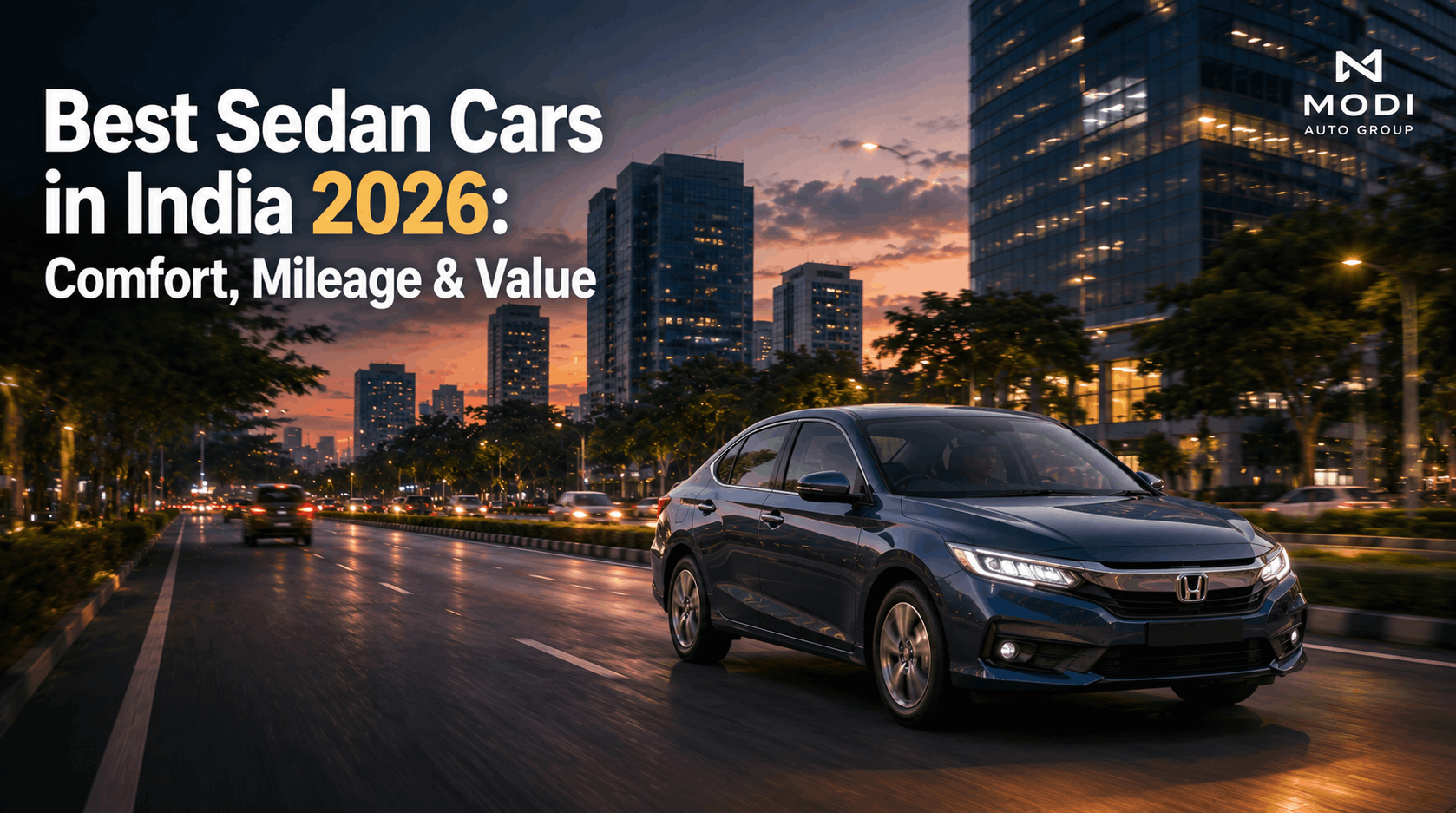
Best Sedan Cars in India 2026: Comfort, Mileage & Value
Sedans were written off a few years ago. Everyone wanted an SUV, the tall stance, the big wheels, the “commanding view.” Yet walk into any showroom in Mumbai or Pune today and you will still see families quietly signing up for a good three-box sedan. Why? Because a well-built sedan does a few things better than almost anything else at its price, and Indian buyers have started noticing again.
If you are shopping for the best sedan in India this year, this guide walks you through the segments, the real trade-offs, and where each of these cars actually fits your life.
Why do people still buy sedans in 2026?
Let me put it simply. A sedan gives you three things an SUV struggles to match at the same money.
- Ride comfort: A lower centre of gravity means less body roll. On long drives, that translates to a settled, planted feel that tired passengers appreciate.
- A proper boot: A sealed 400-litre-plus boot swallows suitcases, and your luggage stays out of the cabin (and out of sight).
- Highway stability: At 100-plus on the expressway, a low-slung sedan feels glued to the road. Crosswinds bother it far less than a tall vehicle.
- Mileage: Lighter body, better aerodynamics. Sedans usually sip less fuel than an equivalent SUV.
So no, the sedan isn’t dead. It just got choosier about who buys it.
Picking your top SUV under 20 lakh is the fun part. Buying it shouldn’t be painful.
Also Read:
Modi Auto Group
we are an authorised dealership for Hyundai, Honda, MG, and Kia across Mumbai and Pune. Whether your shortlist has the Creta, Seltos, Elevate, Hector, or any other SUV from this list, our team can line up test drives, walk you through variants honestly, and help you land the right deal. No pressure, no upselling — just straight talk.
Understanding sedan segments in India
Before we name cars, it helps to know how the market is split. Getting this right saves you from comparing a budget commuter with a mid-size family car.
Compact / sub-4m sedans
These are under four metres long, which earns them a lower tax slab and keeps prices friendly. Great for city use, easy to park, light on the wallet. Within the brands we deal with, the two names here are the Hyundai Aura and the Honda Amaze.
The Aura is the value pick, and it has a party trick: a factory-fitted CNG option. More on that below. The Amaze, now in its refreshed avatar, feels a class above inside and drives with that typical Honda polish.
Mid-size sedans
Step up in size, space, and refinement, and you reach the heart of the market. This is where the Honda City and Hyundai Verna live, and honestly, these are among the top sedan cars in India right now.
The City is the sensible, endlessly reliable benchmark, and it also comes as a City Hybrid (more on the fuel story shortly). The Verna leans younger and sportier, with a turbo-petrol option for those who like a bit of shove.
Premium / luxury sedans: an honest word
Here is where I need to be straight with you. If you are searching for the best luxury sedan in India, you should know how the luxury space works among the brands available at our showrooms.
The mid-size cars above sit at the top of the *mainstream* sedan space. They are premium, well-equipped, and lovely to own, but they are not “luxury” in the badge sense.
For genuine luxury, the marque to look at is Jaguar Land Rover. The catch: JLR’s current India line-up is SUV-led, think Range Rover, Range Rover Sport, Velar, Evoque, Defender, Discovery, and the Jaguar F-PACE. There isn’t a JLR sedan on sale here today. So if your heart is set on a three-box luxury car specifically, that particular box is one this brand group doesn’t tick right now, and I would rather tell you that than oversell. If it’s luxury *motoring* you want (and you’re open on body style), the JLR range is where you look.
The fuel question: petrol vs CNG vs hybrid
This is the decision that actually changes your monthly running cost. Let’s break it down.
Petrol
The default. Smooth, cheap to buy, easy to service anywhere. If you drive modest distances, a plain petrol sedan is the no-fuss choice.
CNG (Hyundai Aura)
Compressed natural gas costs far less per kilometre than petrol. The Hyundai Aura CNG comes factory-fitted, which matters, because a company-engineered system is safer and keeps your warranty intact, unlike an aftermarket kit. If you’re a high-mileage city driver, the fuel savings add up fast. The trade-offs? Slightly less boot space (the cylinder takes up room) and a small dip in power. For many commuters, that’s a fair swap.
Strong hybrid (Honda City Hybrid)
The Honda City Hybrid (badged e:HEV) pairs a petrol engine with electric motors. In city traffic it often runs on the electric motor alone, which is why it returns such strong fuel figures. You never plug it in; the system charges itself. You pay more upfront, but if you cover big distances, the savings and the silky drive can justify it.
Which one is “right”? It depends entirely on how much you drive and where.
Quick comparison: how the sedans stack up
| Model | Segment | Fuel options | Indicative mileage (ARAI) | Indicative ex-showroom range |
|---|---|---|---|---|
| Hyundai Aura | Sub-4m compact | Petrol, CNG | ~20-25 km/l (CNG ~28 km/kg) | ~6.5-9 lakh |
| Honda Amaze | Sub-4m compact | Petrol | ~18-19 km/l | ~8-11 lakh |
| Hyundai Verna | Mid-size | Petrol, turbo-petrol | ~18-21 km/l | ~11-17 lakh |
| Honda City | Mid-size | Petrol | ~17-18 km/l | ~12-16 lakh |
| Honda City Hybrid | Mid-size | Strong hybrid | ~26-27 km/l | ~19-21 lakh |
What about running cost over time?
Sticker price is only half the story. Think about the full picture:
- Fuel per km: CNG wins for pure economy, the hybrid wins for a petrol-like experience with big savings, plain petrol sits in between.
- Service: All these brands have wide, well-run networks, so parts and servicing stay predictable.
- Resale: The Honda City and Hyundai Verna hold value well, thanks to steady demand.
- Insurance: Higher for the pricier hybrid and turbo variants; get a quote before you decide.
A car that costs a little more upfront but saves fuel every day can work out cheaper across five years. Do the math for your own distance.
Where does Modi Auto Group fit in?
When you’re weighing an Aura CNG against a City Hybrid, or wondering whether the Verna turbo is worth the jump, it helps to sit in all of them back to back. As the parent group behind Hyundai, Viva Honda, MG Modi and Jaguar Land Rover, Modi Auto Group lets you line up variants side by side across its dealerships, sort out test drives, and handle financing, insurance and servicing in one place. If you’d like to compare in person, the group’s mainstream and luxury car showroom in Mumbai brands let you take a couple of these home for a spin.
Key takeaways
- Sedans still make sense for ride comfort, boot space, highway stability, and mileage.
- Sub-4m value: Hyundai Aura (with factory CNG) and Honda Amaze.
- Mid-size sweet spot: Honda City and Hyundai Verna, the strongest all-rounders here.
- Best economy story: Aura CNG for low per-km cost; Honda City Hybrid for petrol-like refinement with big savings.
- Luxury intent: No JLR sedan exists in India today; JLR luxury is SUV-led, so plan accordingly.
- Always confirm current on-road prices and variant details before booking.
Also Read: Honda City vs Hyundai Verna 2026: Complete Sedan Comparison
Frequently Asked Questions
1. Which is the safest family car you would recommend?
Look at models with proven crash-test performance and full safety kit. Among the brands here, Hyundai’s Verna, Creta and Venue have scored well in recent testing, while the MG Astor adds ADAS. Any car with 6 airbags, ESC and a good NCAP rating is a sound bet.
2. What is the best 7-seater for a joint family?
The MG Gloster is the plush, long-distance choice, while the MG Hector Plus and Hyundai Alcazar offer three rows at more accessible prices. Pick based on how often you actually fill that last row.
3. Which is a good budget family car?
The Hyundai Grand i10 Nios and Hyundai Aura are gentle on the budget for smaller families, and the Hyundai Exter is a smart entry into the SUV space without stretching too far.
4. Which family car gives the best mileage?
Petrol hatchbacks like the Grand i10 Nios and i20 tend to be efficient for city use, while diesel or hybrid variants of models like the Honda City suit heavy highway drivers. Your driving pattern decides the winner.
5. What suits a typical family of 4 or 5 best?
A compact SUV or sedan usually hits the mark. The Hyundai Creta, Honda Elevate and Honda City all comfortably seat five with room for weekend luggage.