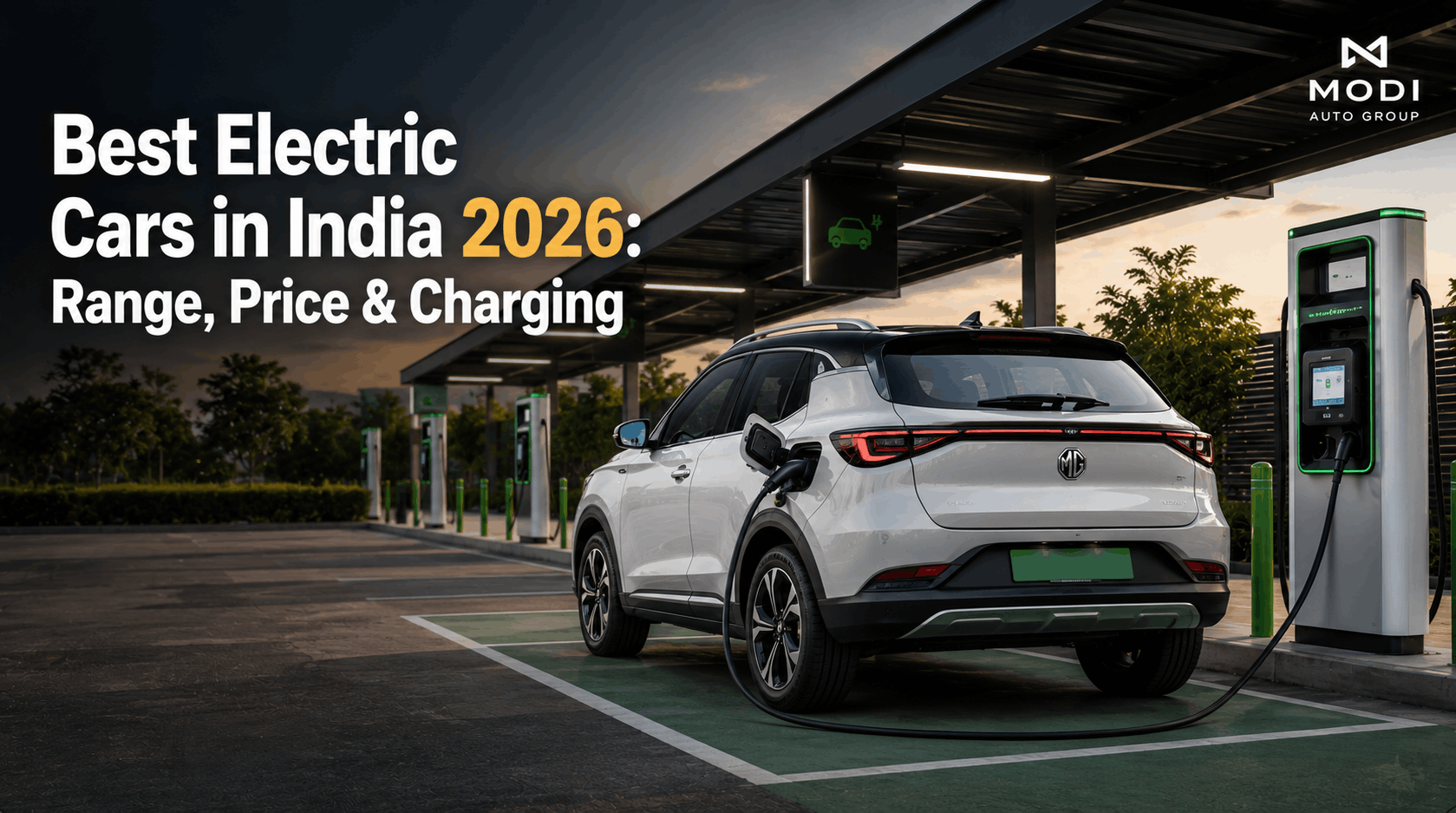
Best Electric Cars in India 2026: Range, Price & Charging
Thinking about switching to an electric car this year? You’re not alone. Petrol prices keep pinching, EV charging points are popping up across Mumbai and Pune, and the models on sale today are far better than what we had even two years ago. But the questions haven’t changed much: how far will it really go, what will it cost, and where do you plug it in?
Let’s break it all down in plain language, and keep the focus on cars you can actually buy through a trusted dealership. A quick note before we start: Modi Auto Group represents Hyundai, Honda (via Viva Honda), MG (via MG Modi) and Jaguar Land Rover. So when we talk about the best EV cars in India from this stable, the two names doing the heavy lifting in the mass market are MG and Hyundai. Honda doesn’t sell a mainstream electric car in India yet, so you won’t see a Honda EV in this list. That’s just being honest with you.
EV basics: what actually matters before you buy
Before picking a model, get comfortable with a handful of terms. They sound technical, but they’re simple once explained.
What does “range” really mean?
Range is how far the car travels on a full charge. Carmakers quote a figure tested under ARAI or MIDC conditions (and sometimes the global WLTP cycle). Here’s the catch: those numbers come from controlled lab-style tests. In real Mumbai traffic, with AC running and a few uphill stretches near Pune, expect roughly 20 to 30 percent less than the claimed figure.
So if a car claims around 450 km, plan your life around 320 to 360 km of comfortable driving. Treat every range number as a best-case ceiling, not a promise.
Battery size (kWh) and why it matters
The battery is measured in kilowatt-hours (kWh). Think of it like the size of your fuel tank. A bigger kWh number usually means more range, but also higher price and slightly longer charging time. A small city car might carry 17-18 kWh, while a long-range SUV can pack 40-60 kWh or more.
AC vs DC charging: the part everyone gets confused about
There are two ways to charge:
- AC charging (slow): This is your home wall box or a regular slow public charger. Gentle on the battery, but slow. A full charge can take anywhere from 6 to 12 hours depending on battery size. Perfect for overnight top-ups.
- DC fast charging (quick): Found at highway and city fast-charging stations. These can take you from roughly 10 percent to 80 percent in about 30 to 60 minutes. Handy for long trips, but a bit pricier per unit.
One tip: fast chargers usually slow down after 80 percent to protect the battery. That last 20 percent always takes longer, so on road trips, most people unplug at 80 and keep moving.
Home vs public charging
Most owners do 80-90 percent of their charging at home. Fit a wall box in your parking spot, plug in at night, wake up to a “full tank.” Public charging is your backup for long drives or if you live in a building without a dedicated charging point (worth checking with your society before you buy).
Picking your top SUV under 20 lakh is the fun part. Buying it shouldn’t be painful.
Also Read:
Modi Auto Group
we are an authorised dealership for Hyundai, Honda, MG, and Kia across Mumbai and Pune. Whether your shortlist has the Creta, Seltos, Elevate, Hector, or any other SUV from this list, our team can line up test drives, walk you through variants honestly, and help you land the right deal. No pressure, no upselling — just straight talk.
Running cost: is an EV actually cheaper?
This is where EVs shine. Let’s compare roughly.
| What you pay for | Petrol car (approx) | Electric car (home charging, approx) |
|---|---|---|
| Cost per km (fuel/energy) | Rs 6 to 8 | Rs 1 to 2 |
| Regular servicing | Higher (oil, filters, etc.) | Lower (fewer moving parts) |
| Fuel/energy price swings | Frequent | More stable |
Charging at home works out to roughly Rs 1 to 2 per km for many EVs, versus Rs 6 to 8 for a petrol car. Over 12,000-15,000 km a year, that difference adds up fast. These are ballpark figures, not fixed numbers, since your electricity tariff and driving style will shift the math.
Then there’s total cost of ownership (TCO), the full picture over five to seven years. EVs cost more upfront but claw it back through cheaper running and lower maintenance. If you drive a lot, the EV usually wins over time. If you barely drive, the sums are closer.
Best electric cars in India 2026 by segment
Now the fun part. Here’s how the top electric cars in India from Hyundai and MG stack up across price and range bands. Remember, all range figures are claimed, so mentally shave off that 20-30 percent.
| Segment | Model | Type | Notes on claimed range |
|---|---|---|---|
| Entry / city | MG Comet EV | Compact city car | Short claimed range; built for city hops |
| Mid-range | MG Windsor EV | Crossover | Comfortable mid claimed range |
| Mid / long-range | Hyundai Creta Electric | SUV | Available in variants with higher claimed range |
| Long-range | MG ZS EV | SUV | Strong claimed highway range |
| Premium long-range | Hyundai Ioniq 5 | Premium SUV | Highest claimed range here, fast DC charging |
Which is the best EV car in India for city driving?
If your world is office-home-market-school runs, the MG Comet EV is the honest answer. It’s tiny, easy to park in crowded lanes, and cheap to charge. Its range is modest, but for daily city use you rarely need more.
Best electric cars in India for families
The MG Windsor EV and Hyundai Creta Electric sit in the sweet spot for most families. Enough space, enough range for weekend getaways, and a price that doesn’t feel outrageous. The Creta Electric, in particular, comes in variants with a bigger battery if you want extra cushion.
Long-range EV cars in India for highway drivers
Regularly doing Mumbai-Pune or longer? Look at the MG ZS EV, the higher-range Hyundai Creta Electric, and the Hyundai Ioniq 5. These carry bigger batteries and support quicker DC fast charging, so a coffee-break top-up gets you moving again.
The premium pick
The Hyundai Ioniq 5 is the standout premium long-range choice here, with the biggest claimed range and genuinely quick fast charging. It’s pricier, but you’re paying for range, tech, and refinement.
Curious how these fit together? Modi Auto Group, the group behind some of Mumbai’s trusted luxury car dealers in Mumbai, helps you weigh range, charging, financing and servicing across Hyundai, MG and more, without the hard sell.
Also Read: Best SUV Under 20 Lakh in India 2026: Top 7 Picks Worth Every Rupee
What about the battery warranty?
A big worry for first-time buyers: “Will the battery die on me?” Modern EV batteries are built to last, and manufacturers back them with long warranties, often around 8 years or a high-kilometre limit. Batteries do lose a little capacity over years, which is normal, but a warranty this long tells you the makers are confident. Always read the exact terms for the model you pick.
Key takeaways
- Claimed range is a ceiling. Real-world figures run 20-30 percent lower.
- Home charging (AC) is cheap and slow; DC fast charging is quick and best for trips.
- Running costs of roughly Rs 1-2 per km beat petrol handily for most drivers.
- Among Modi Auto Group’s brands, MG and Hyundai lead the EV charge; Honda has no mainstream EV in India yet.
- Match the car to your driving: Comet EV for city, Windsor/Creta Electric for families, ZS EV and Ioniq 5 for long range.
Switching to electric isn’t a leap of faith anymore. It’s a practical choice, as long as you go in with clear eyes on range and charging.
Frequently Asked Questions
1. Which EV among these brands has the longest range?
The Hyundai Ioniq 5 carries the highest claimed range in this group, followed by the long-range MG ZS EV and higher-battery Hyundai Creta Electric variants. Remember to plan for real-world figures a fair bit below the claimed number.
2. How long does it take to charge an electric car?
It depends on the charger. A home AC wall box may take 6 to 12 hours for a full charge, while a DC fast charger can get you from about 10 to 80 percent in roughly 30 to 60 minutes.
3. Is an EV genuinely cheaper to run than a petrol car?
For most drivers, yes. Home charging often works out to around Rs 1 to 2 per km against Rs 6 to 8 for petrol. The more you drive, the bigger your savings over time.
4. How long will the battery last, and is it covered?
EV batteries are designed for long life, and makers typically offer warranties around 8 years or a set kilometre limit. Some capacity loss over the years is normal. Check the exact warranty for your chosen model.
5. Which is the best budget EV among these brands?
The MG Comet EV is the most wallet-friendly entry point, ideal for city driving. For a bit more space and range on a moderate budget, the MG Windsor EV is worth a look.