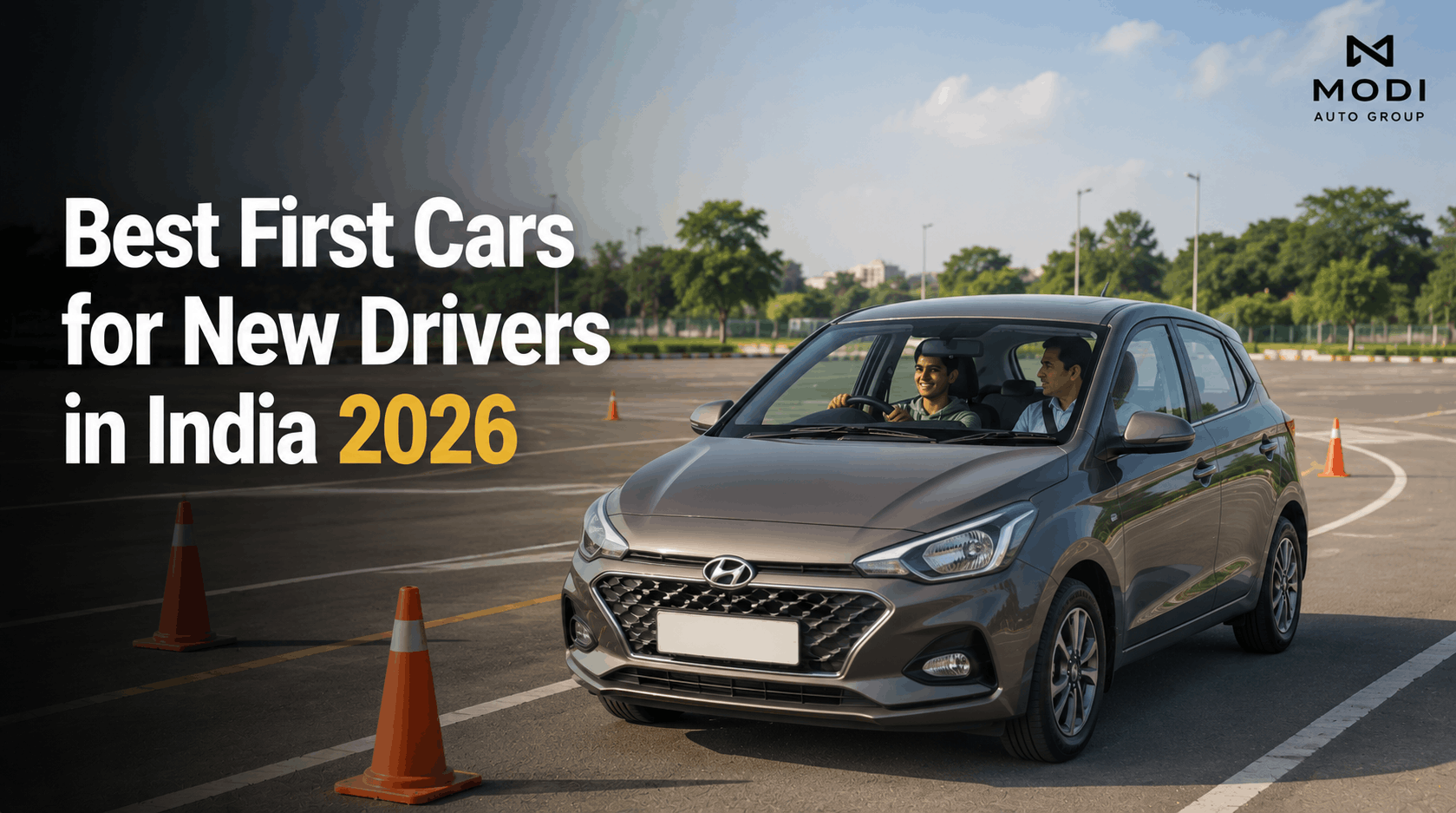
Best First Cars for New Drivers in India 2026
Buying your very first car is a big moment. You have saved for it, maybe practised parallel parking in an empty lot on Sunday mornings, and now you are staring at a dozen brochures wondering which one is actually right for a beginner. The good news? Choosing well is less about horsepower and more about a handful of sensible things that make daily driving easy and safe.
This guide walks you through what genuinely matters for a new driver in 2026, and gives you a realistic shortlist. We will keep the jargon light and explain anything technical the moment it comes up.
What makes a good first car, really?
A car that is easy to learn on shares a few traits. It is small enough to place on a crowded Mumbai lane without breaking a sweat, forgiving when you make mistakes, and cheap enough to run that a spike in fuel prices does not ruin your month.
Here is what to look for:
- Compact size and good visibility. Shorter cars with big windows and a tall seating position let you judge corners and gaps confidently. This alone reduces those nervous first-month scrapes.
- Light steering. Most modern cars have electric power steering, which means the wheel turns with very little effort. A light setup makes city crawls and tight U-turns far less tiring.
- An automatic option. More on this below, but for a first-timer it is often a genuine stress-reliever.
- Safety kit. Airbags, ABS, and a decent crash rating. We will unpack these in a second.
- Affordability and low running cost. Not just the sticker price, but fuel efficiency, servicing bills, and insurance.
- Easy servicing and strong resale. A wide service network means no hunting for spares, and good resale means your first car does not become a money pit when you upgrade.
Picking your top SUV under 20 lakh is the fun part. Buying it shouldn’t be painful.
Also Read:
Modi Auto Group
we are an authorised dealership for Hyundai, Honda, MG, and Kia across Mumbai and Pune. Whether your shortlist has the Creta, Seltos, Elevate, Hector, or any other SUV from this list, our team can line up test drives, walk you through variants honestly, and help you land the right deal. No pressure, no upselling — just straight talk.
Manual or automatic for the best new cars for new drivers?
If you learned on a manual, you can drive one. But should your first owned car be a manual? For many beginners, no. Stalling at a signal on an incline, riding the clutch in bumper-to-bumper traffic, coordinating three pedals while watching mirrors, it is a lot when you are still building confidence.
An AMT (Automated Manual Transmission) is a manual gearbox that shifts itself, so there is no clutch pedal and no gear stick fuss. It is affordable and light on fuel. A CVT (Continuously Variable Transmission), which Honda uses, feels smoother because it has no fixed gear steps, though it costs a bit more.
For learning, an automatic of either kind lets you keep your full attention on the road and traffic. That is worth a great deal in your first year.
Understanding safety without the confusion
Three terms come up constantly, so let us make them simple.
- Airbags are cushions that inflate in a crash to protect your head and chest. Dual front airbags are now standard; six airbags are increasingly common and better.
- ABS (Anti-lock Braking System) stops your wheels from locking when you brake hard, so you can still steer around trouble instead of skidding straight into it.
- Bharat NCAP is India’s own crash-test programme. It puts cars through controlled crashes and awards a star rating out of five, higher stars meaning better protection. When two cars tempt you equally, the star rating is a clean tie-breaker.
A quick priority checklist
Not every feature deserves equal weight. Here is how a sensible first-time buyer might rank things.
| What to prioritise | Why it matters for a beginner | How much to weigh it |
|---|---|---|
| Small footprint + visibility | Easier parking, fewer nervous moments | High |
| Automatic (AMT/CVT) | Frees your attention for the road | High |
| Safety (airbags, ABS, Bharat NCAP) | Protects you while skills are still forming | High |
| Running cost (fuel, insurance, service) | Keeps ownership affordable month to month | High |
| Boot space and rear seat | Nice for family trips, not make-or-break early on | Medium |
| Top-end features (sunroof, big screen) | Pleasant, but never the deciding factor | Low |
The shortlist: best first car to buy in India from our brands
Now for the honest part. Modi Auto Group represents Hyundai, Honda (through Viva Honda), MG (through MG Modi), and Jaguar Land Rover. Within that lineup, the most beginner-friendly and affordable cars come from Hyundai’s small-car range. MG’s cars lean bigger and pricier, and Jaguar Land Rover sits firmly in the premium bracket, so neither is the natural pick for a first-timer on a tight budget. No sugar-coating there.
So a realistic first-car shortlist looks like this:
- Hyundai Grand i10 Nios — a proper hatchback that is compact, light to steer, and easy to park. AMT available. A textbook learner’s car.
- Hyundai Exter — a micro-SUV with a taller seating position, so you sit up and see the road better. Good visibility, modern safety kit, AMT on offer.
- Hyundai Aura — a compact sedan for those who want a boot for luggage without going much bigger overall. AMT available.
- Honda Amaze — a compact sedan that sits a step up in price and polish, with a smooth CVT automatic. A nice choice if your budget stretches a little.
Here is how they compare on the things that matter to a beginner.
| Model | Body type | Automatic | Indicative price range (₹ lakh)* | Best suited to |
|---|---|---|---|---|
| Hyundai Grand i10 Nios | Hatchback | AMT | ~7–10 | City learners, tight parking |
| Hyundai Exter | Micro-SUV | AMT | ~8–12 | Those wanting height and visibility |
| Hyundai Aura | Compact sedan | AMT | ~8–11 | Buyers who need boot space |
| Honda Amaze | Compact sedan | CVT | ~9–13 | A slightly premium step up |
*Ranges are indicative and vary by city, variant, and offers. Always confirm current, exact prices before you commit.
New or certified pre-owned for a first car?
This is a fair question, and the answer depends on you.
A new car gives you a full warranty, the latest safety kit, and zero history to worry about. The trade-off is a steeper price and the sharpest drop in value in the first couple of years.
A certified pre-owned car is a used car that a dealer has inspected, reconditioned, and backed with a limited warranty. You get more metal for your money, and for a beginner who expects a few parking-lot nicks while learning, spending less upfront is genuinely sensible. The key is buying certified from a trusted source, not a random listing, so the inspection and paperwork are real.
There is no wrong answer here. If budget is tight and you are nervous about early scratches, certified pre-owned is a smart, unglamorous choice.
Where a good dealership helps
Picking a first car is easier when someone patiently answers your questions without rushing the sale. Modi Auto Group, the parent group behind the Hyundai, Viva Honda, MG Modi and Jaguar Land Rover dealerships across Mumbai and Pune, helps first-time buyers compare options, book test drives, and sort out financing and insurance. Its dealerships also offer certified pre-owned cars if you would rather start with something gentler on the wallet. If you are still weighing choices, the group’s multi-brand automobile dealership network lets you take a couple of shortlisted models for a spin before deciding.
A test drive, by the way, is non-negotiable. A car that reads perfectly on paper can still feel wrong the moment you sit in it.
Also Read: Best Luxury SUVs in India 2026: Top Picks for Comfort, Tech & Road Presence
Key takeaways
- The best first car is small, easy to see out of, light to steer, and safe, not the one with the flashiest features.
- An automatic (AMT or Honda’s CVT) lets a new driver focus on the road instead of the clutch.
- Within Hyundai, Honda, MG, and Jaguar Land Rover, the friendliest beginner picks are Hyundai’s small cars: Grand i10 Nios, Exter, and Aura, with the Honda Amaze as a step up.
- Weigh running cost and safety as heavily as price. Check the Bharat NCAP rating as a tie-breaker.
- Certified pre-owned is a perfectly good, budget-friendly start; buy it certified from a trusted dealer.
- Confirm current prices and always take a test drive before you sign.
Frequently Asked Questions
1. Is a manual or automatic better for my first car?
For most beginners, an automatic wins. Without a clutch to manage, you can concentrate on traffic, mirrors, and lane discipline while your confidence grows. Manuals are cheaper and give you more control once you are experienced, but that first year is far calmer in an AMT or CVT.
2. Should a beginner buy new or used?
Both work. New gives you a full warranty and peace of mind; certified pre-owned stretches your budget and stings less when you pick up that inevitable first parking scratch. If money is tight, a certified used car from a reputable dealer is a wise, no-drama start.
3. Which is the safest first car among these brands?
Look at the Bharat NCAP star rating for the specific model and variant you are considering, since ratings and safety kit differ across trims. Among the beginner-friendly options here, Hyundai’s Exter and its small-car range come with modern safety features like multiple airbags and ABS. Always verify the current rating for the exact variant.
4. What is the easiest car to drive for a beginner?
A compact car with light steering and good all-round visibility. The Hyundai Grand i10 Nios is about as fuss-free as it gets in the city, and the Hyundai Exter’s taller seating helps you judge the road better. An automatic version of either makes learning noticeably smoother.
5. How much should I budget for a decent first car?
It depends on new versus used and your city’s on-road costs. As a rough guide, the beginner-friendly models here sit indicatively in the ₹7-13 lakh on-road band when new, with certified pre-owned options costing less. Remember to budget for insurance, registration, and a service or two, and confirm live prices before deciding.