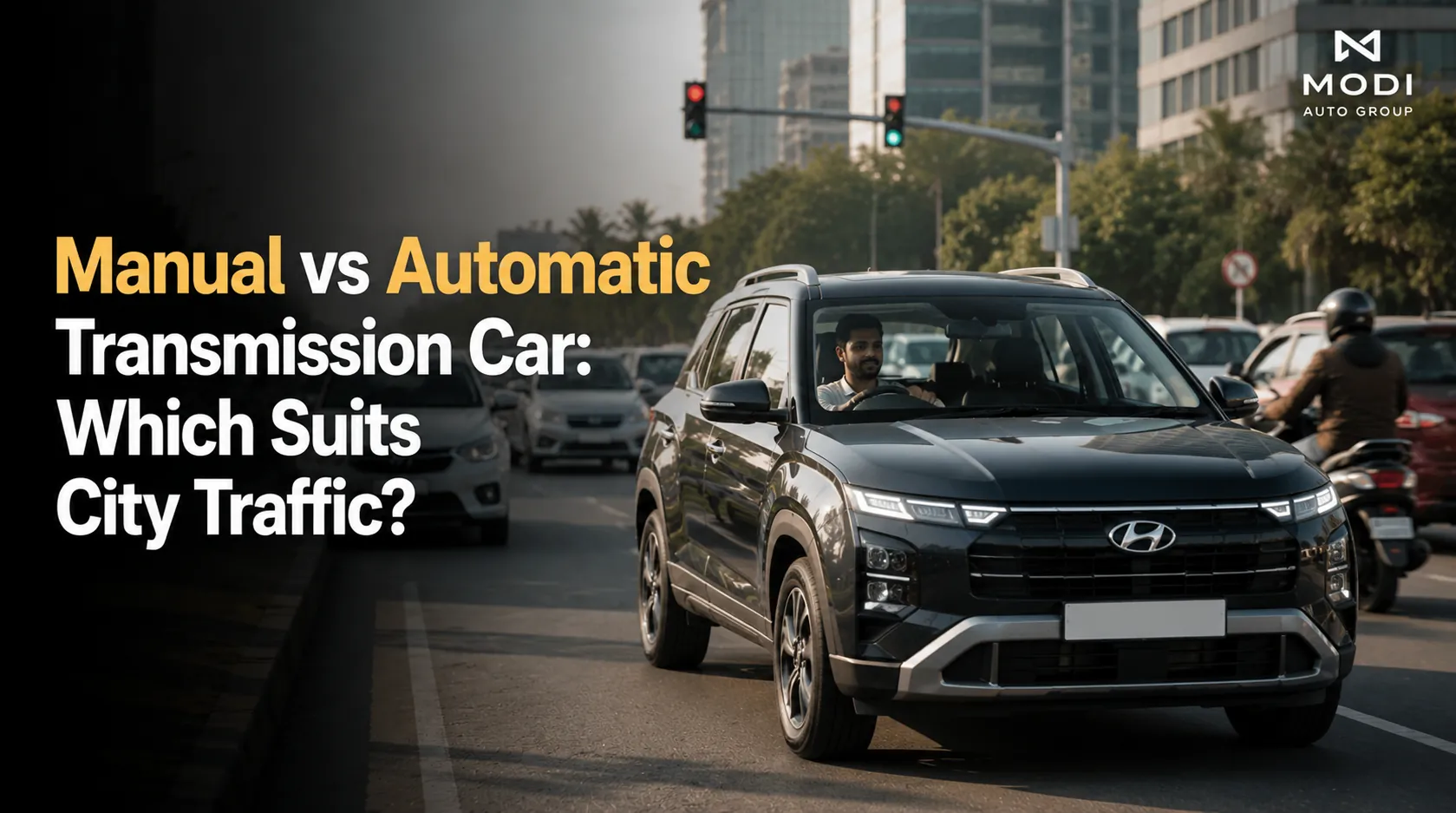
Manual vs Automatic Transmission Car: Which Suits City Traffic?
Anyone who drives daily in a city like Mumbai has asked the question at some point, usually while crawling through a jam with an aching left leg. Is it finally time to switch to an automatic? The manual vs automatic car debate is not really about which is objectively better. It is about which one suits how and where you actually drive. And in dense, stop-go traffic, the answer leans a particular way for a lot of people.
Let’s break down the real difference between the two, how each behaves in city conditions, and the cost, mileage and maintenance trade-offs that should shape your choice. By the end you should know which one fits your commute.
What is the difference between an automatic and a manual car?
The core difference is simple. A manual car has a clutch pedal and a gear lever you operate yourself. An automatic changes gears on its own, leaving you with just an accelerator and a brake. That’s it, and yet it changes the entire feel of driving.
Manuals hand the driver full control over gear selection, which some people genuinely enjoy. Automatics remove that task completely, and they remove it exactly when traffic makes constant shifting most tiring. Modern automatics come in a few flavours, such as CVT, torque converter, AMT and dual-clutch, but from the driver’s seat they all share one appeal: no clutch, no manual shifting.
Which is better for Mumbai city traffic?
For heavy, stop-go city traffic, an automatic is usually the more comfortable choice. When you are inching forward every few seconds, an automatic spares you the endless clutch-and-gear routine that turns a routine commute into a workout for your left leg. Less fatigue means a calmer, more focused drive, which matters when the traffic around you is unpredictable.
That said, a manual still suits plenty of drivers. If you enjoy control, cover more highway than city, or want the lowest possible upfront cost, it remains a sensible pick. The honest answer really comes down to your daily route:
- Mostly bumper-to-bumper city driving: an automatic reduces strain and stress noticeably.
- Mostly open roads and highways: a manual is perfectly comfortable and often cheaper to buy.
- A mix, with comfort as your priority: an automatic is the easier daily companion.
Pros and cons at a glance
Automatic
- Pros: effortless in traffic, far less driver fatigue, and easy for new or nervous drivers.
- Cons: usually a higher purchase price, and some gearbox types can cost more to maintain.
Manual
- Pros: lower upfront cost, familiar to most Indian drivers, and full control over the drive.
- Cons: tiring in constant traffic, and clutch wear tends to add up with heavy city use.
Cost, mileage and maintenance considerations
A few practical points are worth weighing before you decide. Automatics typically cost more to buy than the equivalent manual variant of the same car, so there is a price premium to factor in. On fuel efficiency, older automatics clearly lagged behind manuals, but many modern automatics have closed most of that gap, so the difference today is smaller than the old reputation suggests. Maintenance depends heavily on the type of gearbox, which is why it is worth checking the specifics for the exact model you are considering rather than relying on general rules.
There is also resale to think about. In many cities, automatics have grown steadily more popular, which can support their resale demand, though this varies by model and segment.
How to decide with a test drive
Reading about it only takes you so far. The real difference is something you feel, not something you calculate, so a back-to-back test drive is the best way to choose.
Modi Auto Group is the parent company behind several brand showrooms in Mumbai, and its auto dealerships near me network lets you try manual and automatic variants of the same car one after the other. You could drive a Honda at Viva Honda, an MG at MG Modi, or a Hyundai at Modi Hyundai, at the relevant brand’s showroom, and let your own commute be the deciding vote.
Which type of automatic should you look for?
If you settle on an automatic, it helps to know the common types, because they feel and cost quite different. A CVT tends to be smooth and efficient, and it suits relaxed city driving well. A torque converter is a proven, comfortable option often found in slightly larger cars. An AMT is usually the most affordable automatic, though its shifts can feel a little less seamless. A dual-clutch gearbox is quick and sporty, but it tends to appear in pricier cars.
For everyday Mumbai commuting, smoothness and reliability usually matter more than outright sportiness, so many buyers gravitate towards a CVT or a torque converter. The right pick still depends on the specific car and your budget, which is one more reason to test drive the actual variant rather than choose on paper.
Conclusion
In Mumbai’s traffic, an automatic transmission is the more comfortable everyday choice for most drivers, simply because it removes the constant clutch work that makes stop-go driving so tiring. A manual still makes real sense if you value control, drive more highway than city, or want the lower upfront price. Weigh comfort against cost, check mileage and maintenance for the specific model, and let a test drive settle the argument.
Trying both in real conditions is worth the effort. The brand partners under Modi Auto Group can arrange test drives of manual and automatic variants so you can judge which one genuinely suits your commute before you commit. A short back-to-back drive often settles in ten minutes a debate that could otherwise drag on for weeks, and it costs you nothing but a little time.
Frequently Asked Questions
1. Is an automatic car better than a manual for city driving?
For heavy stop-go city traffic, an automatic is usually more comfortable, because it removes the constant clutch-and-gear effort that tires drivers in jams. A manual still suits those who prefer control or drive mostly on highways.
2. Do automatic cars give lower mileage than manuals?
Older automatics were less efficient, but many modern automatics have narrowed the gap considerably. The difference is smaller than it once was, so check the figures for the specific model and variant you are considering.
3. Are automatic cars more expensive to maintain?
It depends on the type of gearbox. Some automatics can cost more to service than a manual, while others are fairly comparable. Confirm maintenance expectations for the exact model with the dealership.
4. Is a manual car harder to drive in traffic?
In constant stop-go traffic, a manual needs frequent clutch and gear use, which many drivers find tiring over time. On open roads it is perfectly comfortable, so your daily route is the biggest factor.
5. Do automatic cars cost more to buy?
Usually, yes. The automatic version of a car typically carries a price premium over the equivalent manual variant, so factor that into your budget alongside the running-cost picture.
6. Can I test drive both manual and automatic versions?
Yes. Authorised dealerships usually offer both. Modi Auto Group’s brand showrooms, such as Viva Honda and MG Modi, can arrange back-to-back test drives so you can feel the difference before deciding.