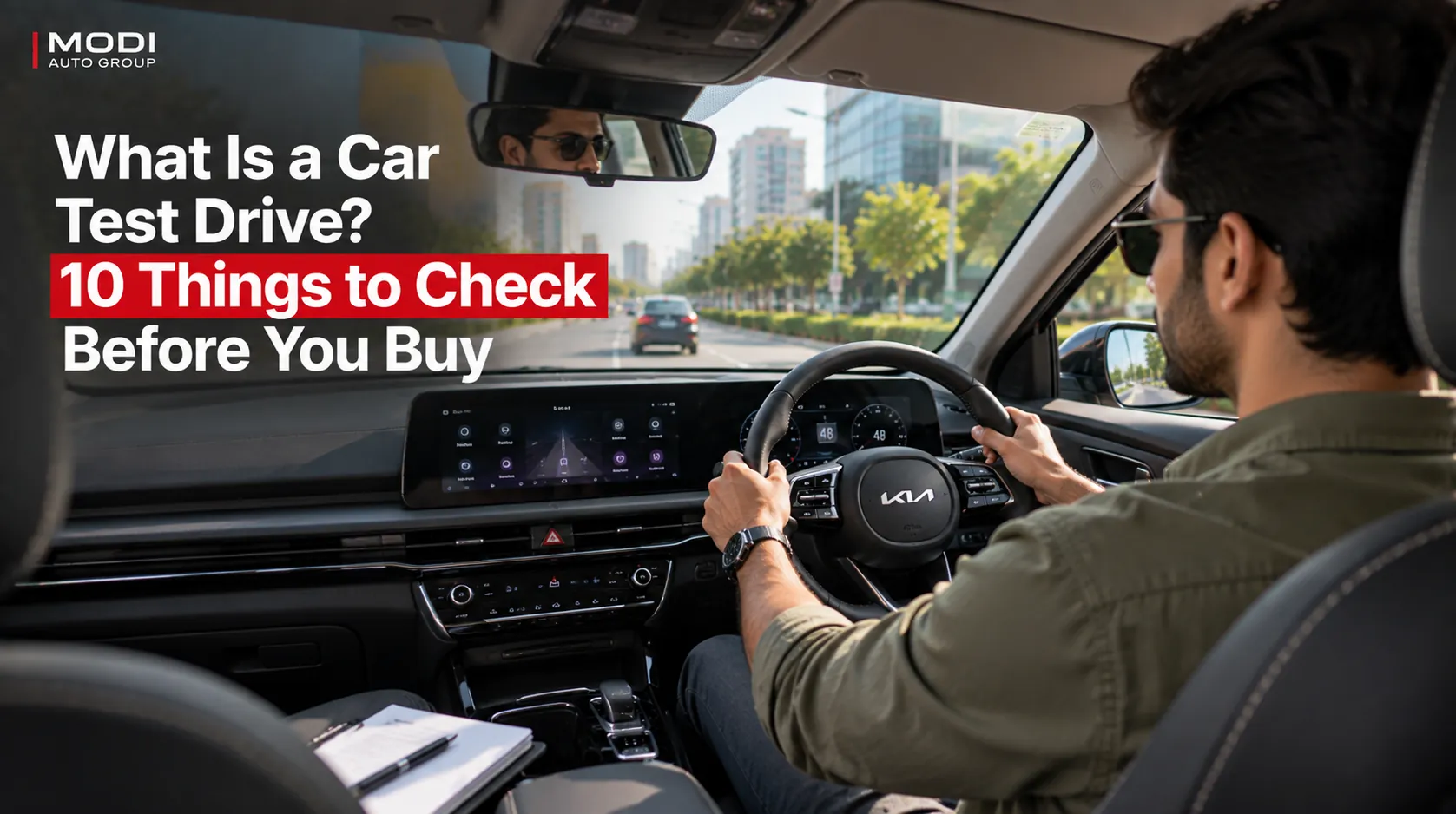
What Is a Car Test Drive? 10 Things to Check Before You Buy
A test drive is your only real chance to feel how a car behaves before committing to it, yet a lot of buyers treat it as a formality: a quick loop around the block that confirms what they’d already decided from the brochure. Knowing how to test drive a car properly, not just driving around the block, is what actually reveals whether it fits your daily life. Used properly, a test drive can reveal things about comfort, visibility and handling that no spec sheet ever will.
1. Driving position and comfort
Spend a minute adjusting the seat, steering wheel and mirrors before you even start driving. If you can’t find a comfortable position in the showroom, it won’t improve on a longer drive later. This applies whether you’re at a mainstream outlet or a luxury car showroom in Mumbai like Modi Auto Group’s JLR outlet. If you’re undecided on transmission, it’s worth reading manual vs automatic for city traffic before your test drive, so you know what to pay attention to behind the wheel.
2. Visibility from the driver’s seat
Check your sightlines in all directions: over the bonnet, through the rear windscreen, and across the blind spots created by thick pillars. Poor visibility is something you’ll notice every single day, not just occasionally.
3. Ride quality over uneven surfaces
If possible, drive over a speed bump or a rougher patch of road, not just smooth showroom-adjacent tarmac. How the suspension absorbs bumps tells you a lot about long-term comfort, especially on daily commutes.
4. Engine response and gear shifts
Notice how the car responds when you accelerate from a standstill and while overtaking. For an automatic, pay attention to how smoothly it shifts; for a manual, notice the clutch feel and gear engagement.
5. Braking feel
Test the brakes at both low and moderate speed in a controlled setting. They should feel responsive without being either too sharp or too spongy.
6. Noise levels inside the cabin
Notice engine noise, wind noise at higher speeds, and any rattles from the interior trim. A quiet cabin matters more than it seems once you’re driving daily.
7. Turning radius and low-speed manoeuvring
Try a U-turn or reverse into a parking spot if the showroom layout allows it. This tells you how easy the car will be to manage in tight city parking and narrow lanes.
8. Infotainment and connectivity
Actually connect your phone via Bluetooth or Android Auto/Apple CarPlay during the drive, rather than just glancing at the screen while parked. Interfaces that look fine standing still can be fiddly to use while driving.
9. Air conditioning performance
Run the air conditioning through the test drive, not just at the start, and notice how quickly it cools and how well it’s distributed to rear seats if you have passengers.
10. Boot space and practicality
Check whether your typical luggage, or a stroller, or sports equipment, actually fits, and don’t rely on the advertised litre capacity alone, since real-world usability depends on the shape of the space as much as its volume.
Conclusion
These car test drive tips take a bit longer than the usual quick loop around the block, but they’ll save you from surprises after you’ve signed. Go through comfort, visibility, ride quality, braking, noise and practicality deliberately, ideally over more than one type of road surface, before you make your decision.
Modi Auto Group’s brand showrooms across Mumbai (Viva Honda, Modi Hyundai, MG Modi and premium partner Jaguar Land Rover) encourage a proper, unhurried test drive before you decide.
Frequently Asked Questions
1. What should I check during a car test drive?
Here’s what to check during car test drive sessions: driving position and comfort, visibility, ride quality over uneven surfaces, engine response, braking feel, cabin noise, low-speed manoeuvring, infotainment, air conditioning and boot practicality.
2. How long should a car test drive be?
Longer than a quick loop around the block. Ideally, drive over more than one type of road surface (smooth and slightly uneven) to get a fair sense of ride quality and comfort.
3. Should I test drive a car more than once?
If you’re close to deciding between two variants or models, a second test drive, perhaps at a different time of day or road condition, can help confirm your first impression.
4. What is the most overlooked part of a test drive?
Real-world practicality checks, like actually connecting your phone to the infotainment system or fitting your typical luggage in the boot, are often skipped in favour of just checking acceleration and handling.
5. Can I test drive a car without a driving licence?
No, a valid driving licence is required to test drive a car yourself. Some showrooms may offer a demo ride where a staff member drives instead, if you’d like to experience the car without driving it.