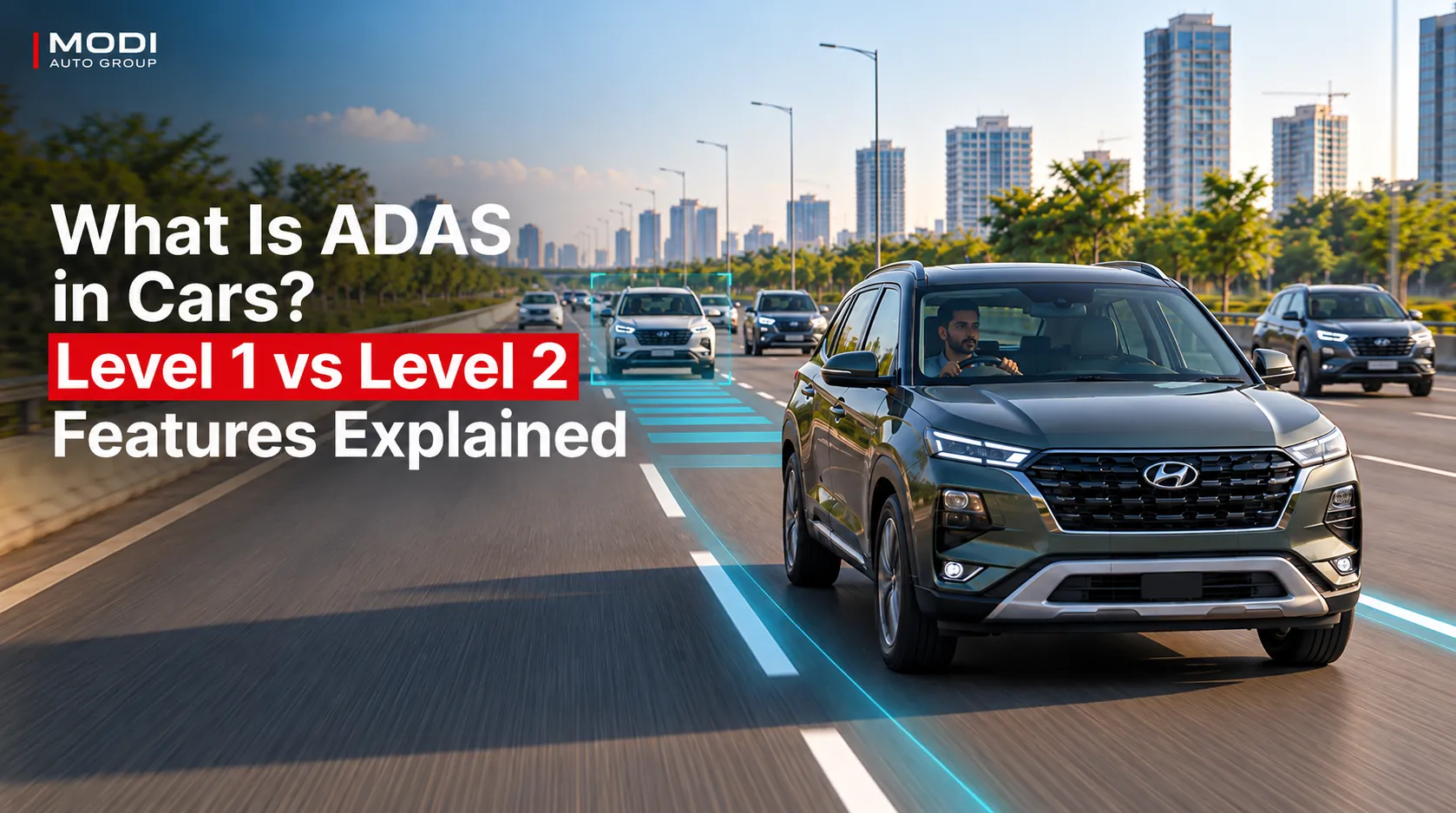
What Is ADAS in Cars? Level 1 vs Level 2 Features Explained
A few years ago, ADAS was something you read about in reviews of imported luxury cars. Today you’ll find it in the brochure of a family sedan or a compact SUV, often printed in bold on the top variant’s feature list. Salespeople mention it, ads mention it, and the badge on the back of some cars even says it. But ask most buyers what it actually does, and the answers get vague.
So, what is ADAS in a car? This guide covers the ADAS meaning in plain terms, the features you’ll actually use, how Level 1 differs from Level 2, and what to keep in mind before paying extra for it on Indian roads.
1. ADAS Meaning: What Does ADAS Stand For?
ADAS stands for Advanced Driver Assistance Systems. It’s not one single feature. It’s a group of safety and convenience functions that use cameras, radar and sensors to watch the road around the car, warn you about danger and, in some situations, step in by braking or steering.
The key word is assistance. ADAS helps the driver. It doesn’t replace them. You still need your hands on the wheel and your eyes on the road at all times.
2. What Is ADAS System in Car and How Does It Work?
Most ADAS setups rely on two kinds of “eyes”. A camera, usually mounted behind the windscreen near the rear-view mirror, reads lane markings, vehicles and sometimes pedestrians. A radar unit, often hidden behind the front grille or bumper, measures how far away the vehicle ahead is and how fast the gap is closing. Some cars use only a camera; others combine camera and radar.
The car’s computer constantly processes what these sensors see. If it spots a risk, say the car ahead braking hard while you’re looking at your phone’s navigation, it first warns you with a beep or a flashing alert. If you don’t react in time, certain features can apply the brakes or nudge the steering themselves.
3. Common ADAS Features in Car
The exact list varies by brand and variant, but these are the ADAS features you’ll see most often in India:
Forward collision warning and autonomous emergency braking (AEB)
Warns you if you’re closing in too fast on the vehicle ahead, and can brake automatically if you don’t respond. Arguably the most valuable feature of the lot.
Lane departure warning and lane keep assist
Alerts you if the car drifts out of its lane without an indicator. Lane keep assist goes a step further and gently steers you back.
Adaptive cruise control
Regular cruise control holds a set speed. Adaptive cruise control also keeps a set distance from the car in front, slowing down and speeding up with traffic. Some versions can bring the car to a stop and pull away again.
Blind spot monitoring
Uses sensors or cameras to warn you when a vehicle is in your blind spot as you change lanes. Very handy with two-wheelers weaving through traffic.
Rear cross traffic alert
Watches for vehicles approaching from the sides while you’re reversing out of a parking spot.
High beam assist and driver attention warning
The first switches between high and low beam automatically when it detects oncoming traffic. The second watches for signs of tiredness and suggests a break on long drives.
4. ADAS Levels Explained: Level 1 vs Level 2
Driving automation is commonly described on a scale from Level 0 (no automation) to Level 5 (a car that drives itself everywhere). Cars sold in India today sit at Level 1 or Level 2.
| Level 1 | Level 2 | |
| What it does | Assists with either steering or speed, one at a time | Can control steering and speed together, in certain conditions |
| Typical example | Adaptive cruise control on its own, or lane keep assist on its own | Adaptive cruise control working together with lane centring |
| Driver’s role | Fully in charge | Fully in charge, hands on the wheel, ready to take over |
In simple terms, a Level 1 system helps with one job. A Level 2 system can handle both speed and lane-keeping at the same time on a well-marked highway. Neither one lets you take your attention off the road, and that’s worth repeating, because the “Level 2” label is sometimes misunderstood as self-driving. It isn’t.
5. ADAS Level 2 Cars in India
ADAS has moved quickly from premium SUVs into mainstream segments. A few examples from brands sold through Modi Auto Group’s showrooms:
- Honda: Honda Sensing, a camera-based suite, is offered on models including the City, Elevate and Amaze.
- Hyundai: Hyundai SmartSense is available on models such as the Verna, Creta and Alcazar.
- MG: Level 2 ADAS is offered on models such as the Astor and Hector.
- Kia: ADAS is available on models including the Seltos and Carens Clavis.
In most cases ADAS comes only on higher variants, and the feature list differs from one variant to the next, so check the exact variant sheet before booking. Our guide on choosing the right car variant helps you decide whether the jump to an ADAS-equipped trim is worth it for you. If you’re shortlisting SUVs, many of the picks in our list of the best SUVs under 20 lakh offer ADAS on upper trims.
6. Does ADAS Work Well on Indian Roads?
It works, with a few honest caveats. ADAS was designed around clear lane markings and predictable traffic, and Mumbai doesn’t always offer either.
- Faded or missing lane markings can confuse lane keep assist, so it may switch itself off.
- Two-wheelers cutting in can trigger sudden collision warnings in dense traffic.
- Heavy monsoon rain, dirt or glare can block the camera or radar and temporarily disable features.
- Frequent beeps in stop-start traffic can get annoying, though most cars let you adjust sensitivity or switch individual alerts off.
Where ADAS really earns its keep is on highways and expressways, and in those split-second moments when attention slips. Automatic emergency braking alone can be the difference between a close call and a collision.
7. Is ADAS Worth Paying Extra For?
If you drive often on highways like the Mumbai-Pune Expressway, or do long weekend trips with family, ADAS is well worth considering. If your driving is almost entirely short city runs, its benefits are smaller, though features like AEB and blind spot monitoring still add a useful safety layer. The best way to decide is to experience it on a test drive. Any car showroom in Mumbai run by Modi Auto Group can arrange a drive in an ADAS-equipped variant, so you can see how it behaves in real traffic before deciding.
One practical tip: ADAS cameras and sensors need correct calibration. After a windscreen replacement, bumper repair or wheel alignment, get the system checked at an authorised workshop. You can book a car service through Modi Auto Group for this.
Also Read: Best Family Cars in India 2026: Safe, Spacious & Value Picks
Conclusion
ADAS is a set of driver assistance features that use cameras and radar to warn you about risks and, when needed, brake or steer for you. Level 1 helps with one task at a time, while Level 2 can manage speed and steering together in the right conditions. Neither makes the car self-driving. On Indian roads it’s most useful on highways and in moments of distraction, and features like emergency braking can genuinely prevent accidents.
To try ADAS for yourself, visit Modi Auto Group’s brand showrooms across Mumbai, including Viva Honda, Modi Hyundai and MG Modi, and ask for a test drive in an ADAS-equipped variant.
Frequently Asked Questions
1. What is ADAS in a car?
ADAS, or Advanced Driver Assistance Systems, is a group of safety features that use cameras, radar and sensors to warn the driver about risks and, in some cases, brake or steer automatically.
2. What is the meaning of ADAS Level 2?
Level 2 means the system can control steering and speed at the same time in certain conditions, such as adaptive cruise control combined with lane centring. The driver must stay alert with hands on the wheel.
3. What are the main ADAS features in a car?
Common features include autonomous emergency braking, forward collision warning, lane keep assist, adaptive cruise control, blind spot monitoring, rear cross traffic alert and high beam assist.
4. Is ADAS useful on Indian roads?
Yes, especially on highways and expressways. In dense city traffic, faded lane markings and two-wheelers can cause extra alerts, but features like emergency braking still add real safety.
5. Can I switch off ADAS features?
Most cars let you switch off or adjust individual ADAS alerts through the settings menu. Some safety features may switch back on automatically each time you start the car.