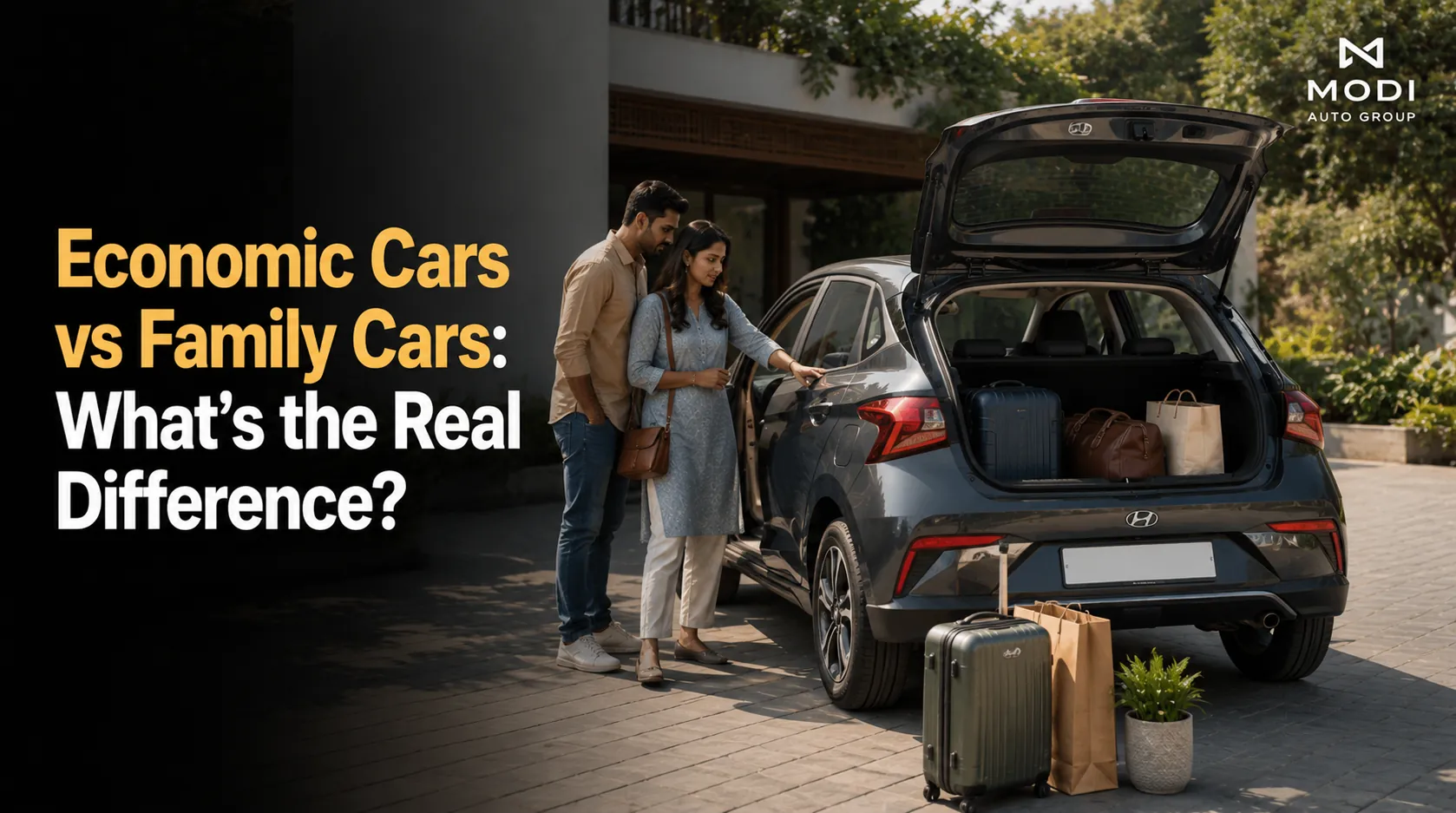
Economic Cars vs Family Cars: What's the Real Difference?
The words economy car and family car get thrown around as if they were opposites, but they actually answer two completely different questions. One is about how much the car costs to run. The other is about how many people and how much life it has to carry. Plenty of cars manage to be both, which is exactly where the confusion starts, especially for a middle-class family trying to pick a single car that does everything.
So what is the real difference, and which should you actually choose? Let’s define each properly, look at where they genuinely diverge, and work out how to decide when your budget and your family both have a say in the matter.
What is an economy car, and what is a family car?
An economy car is defined by low cost of ownership. It is affordable to buy, efficient on fuel, and cheap to maintain. Compact, sensible, and easy on the wallet. Many of the most economical cars in India are hatchbacks and small sedans built with precisely this priority in mind.
A family car is defined by practicality for a household. It has enough seats, boot space, comfort and safety to carry four or five people plus their luggage without anyone grumbling. Notice that this is a role, not a fixed size, though in practice it usually means a roomier sedan or an SUV.
Here is the key point that clears up the confusion. Economy describes cost. Family describes capability. A car can lean towards one, lean towards the other, or strike a balance between the two.
Picking your top SUV under 20 lakh is the fun part. Buying it shouldn’t be painful.
Also Read:
Modi Auto Group
we are an authorised dealership for Hyundai, Honda, MG, and Kia across Mumbai and Pune. Whether your shortlist has the Creta, Seltos, Elevate, Hector, or any other SUV from this list, our team can line up test drives, walk you through variants honestly, and help you land the right deal. No pressure, no upselling — just straight talk.
The real differences that matter
When you line the two mindsets up side by side, a handful of practical differences stand out:
- Space: family cars prioritise cabin and boot room, while pure economy cars keep things compact.
- Running cost: economy cars chase the best fuel efficiency and the lowest upkeep.
- Features and safety: family-focused cars often add comfort and safety kit, which nudges the price up.
- Purchase price: economy models start lower, while roomier family models cost more.
None of these makes one type better than the other. They are simply tuned for different priorities, and the right pick depends entirely on yours.
Picking your top SUV under 20 lakh is the fun part. Buying it shouldn’t be painful.
Also Read:
Modi Auto Group
we are an authorised dealership for Hyundai, Honda, MG, and Kia across Mumbai and Pune. Whether your shortlist has the Creta, Seltos, Elevate, Hector, or any other SUV from this list, our team can line up test drives, walk you through variants honestly, and help you land the right deal. No pressure, no upselling — just straight talk.
Which should you choose?
For a car for a middle-class family, the sweet spot is usually a car that is economical to run and practical enough for the household. The good news is that you rarely have to pick an extreme. A fuel-efficient compact sedan or a value-focused compact SUV often delivers both in one package.
A simple way to decide:
- Count your regular passengers and typical luggage to set your real space needs.
- Fix your on-road budget, and a comfortable EMI if you are financing.
- Prioritise fuel efficiency and low maintenance if running cost is your main worry.
- Never compromise on core safety features just to save a little upfront.
Because the best balance differs for every household, seeing a few options in person helps a lot. Modi Auto Group is the parent company behind Mumbai brand showrooms like Viva Honda, Modi Hyundai and MG Modi, and it brings several car dealerships together, so you can compare economical and family-friendly models across brands and then visit the specific showroom that fits your shortlist.
Running costs over five years, not five minutes
One habit separates savvy buyers from the rest. They think about the cost of the car over years of ownership, not just the price on the day. Fuel, servicing, insurance renewals and tyres add up, and a slightly cheaper car that drinks fuel or needs frequent repairs can end up costing more than a pricier one that sips fuel and rarely misbehaves. When you compare an economy car with a family car, run the numbers over a realistic ownership period, and the smarter choice often looks different from the showroom-day maths.
Common myths worth clearing up
A few stubborn myths cloud this decision. The first is that an economy car cannot also be a family car. In reality, many efficient compact cars comfortably seat a family of four and handle daily duties with ease. The second is that a family car must be big and thirsty, when plenty of family-friendly models are surprisingly light on fuel. The third is that spending more automatically buys more safety, when core safety features now appear across many affordable cars, so the sensible move is to check the specific variant rather than assume.
Seeing past these myths helps you judge cars on what they actually offer, rather than on the label they happen to wear. Compare real space, real running costs and the real safety kit of each variant, and the right choice for your household usually becomes clear. Ask the showroom to walk you through the feature and safety list variant by variant, so nothing is left to guesswork.
Conclusion
The real difference is simple once you name it. An economy car is about spending less to own and run. A family car is about carrying your household in comfort and safety. Most buyers do not have to choose an extreme, because a practical, efficient car can play both roles well. Start from your space needs and budget, keep safety non-negotiable, and let those two anchors guide the shortlist.
To see which cars strike that balance for you, the brand partners under Modi Auto Group across Mumbai can help you compare space, features and running costs before you decide. Take your time over the shortlist, because the car that fits your family and your budget today will still need to serve both comfortably a few years from now.
Frequently Asked Questions
1. What is the difference between an economy car and a family car?
An economy car is defined by low buying and running costs, while a family car is defined by space, comfort and safety for a household. Economy is about cost, family is about capability, and many cars balance both.
2. Which car is best for a middle-class family in India?
Usually a car that is both economical to run and practical enough for the family, such as a fuel-efficient compact sedan or a value-focused compact SUV. The right choice depends on your space needs, budget and priorities.
3. Are family cars more expensive to run?
They can be if they are larger or more feature-rich, but many family-oriented cars are still quite economical. Fuel efficiency and maintenance vary by model, so compare the specific cars on your shortlist.
4. Should I prioritise mileage or space?
Base it on your life. If you regularly carry four or five people and luggage, space and comfort matter more. If it is mostly solo or two-person city use with cost as the priority, lean towards efficiency. Never cut core safety to save money.
5. How do I compare running costs between cars?
Look beyond the purchase price at fuel efficiency, servicing costs, insurance and tyres over a realistic ownership period of several years. A cheaper car with high running costs can end up costing more overall.
6. Where can I compare economical and family cars in Mumbai?
A multi-brand group makes comparison easier. Modi Auto Group’s authorised showrooms, such as Viva Honda, Modi Hyundai and MG Modi, let you weigh space, features and running costs across brands.